Beyond White Paint: Why SRI is the Metric That Matters for Net-Zero Cooling
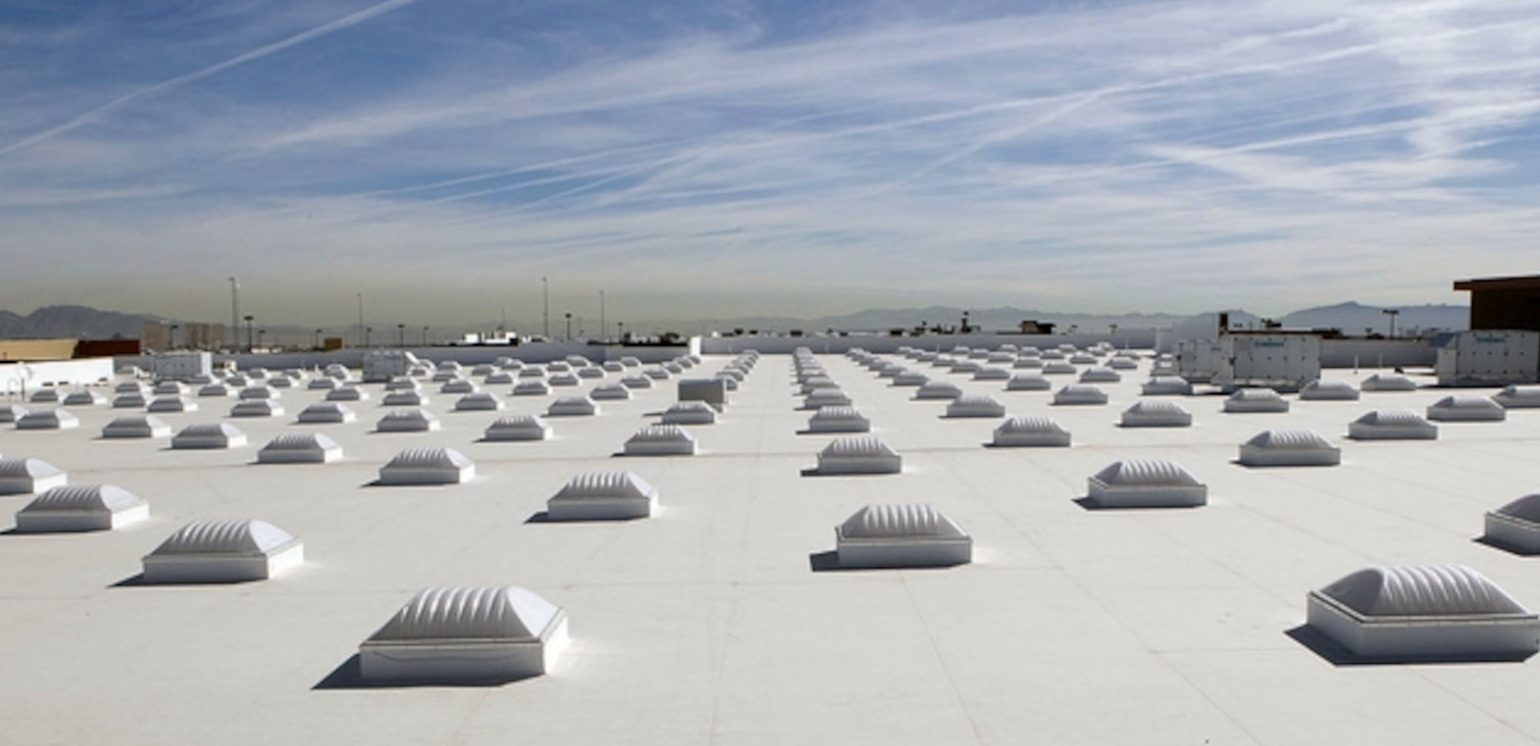
In the race to decarbonize our built environment, the roof has become a primary battlefield. For years, the industry standard for cooling a building surface was simple: paint it white. But as global temperatures rise and energy costs soar, "standard white" is no longer enough. To understand why, we have to look beyond simple color and into the science of the Solar Reflective Index (SRI).
At Pirta, our PDRC (Passive Daytime Radiative Cooling) technology has achieved an unprecedented SRI of 117.66. To put that in perspective, standard professional-grade white paint typically anchors the scale at 100. Understanding how we broke the scale—and why that matters for your bottom line—requires a deep dive into the physics of heat.
Understanding the SRI Formula
The Solar Reflective Index isn’t just one measurement; it is a composite value that calculates a surface’s ability to reject solar heat. It is governed by two distinct physical properties:
Solar Reflectance (Albedo): The fraction of solar energy (visible, infrared, and ultraviolet) reflected by the surface.
Thermal Emittance: The ability of a material to "shed" the heat it has already absorbed by radiating it away as long-wave infrared energy.
The SRI scale was originally defined such that a standard black surface (reflectance 0.05, emittance 0.90) is 0, and a standard white surface (reflectance 0.80, emittance 0.90) is 100.
How Pirta Achieves an SRI of 117.66
If 100 was designed to be the "perfect" white, how does Pirta reach 117.66? The answer lies in Passive Daytime Radiative Cooling (PDRC).
Standard white paints are effective at reflecting visible light, but they often struggle with the near-infrared spectrum, which accounts for about 50% of solar heat. Furthermore, their emittance is limited by the chemistry of their binders.
Pirta’s coating, powered by our Nivi technology, optimizes the pigment-to-binder ratio and utilizes specialized structures that don't just reflect light—they actively emit heat into the "Atmospheric Window." This is a specific frequency range (8–13 micrometers) where the Earth’s atmosphere is transparent, allowing thermal radiation to pass through and escape directly into the cold vacuum of deep space.
By reflecting nearly all incoming solar radiation and simultaneously "pumping" internal heat out into space, Pirta can actually maintain a surface temperature below the ambient air temperature, even under direct peak-noon sunlight.
The Direct Translation to Energy Savings
Why should a facility manager or data center operator care about a 17.66-point jump in SRI? Because the relationship between SRI and energy consumption is significant.
Reduction in "Heat Flux": A higher SRI reduces the amount of heat conducted through the roof deck into the building. For every 10% increase in solar reflectance, a building can see a significant drop in cooling loads.
HVAC Efficiency: Air conditioning units (RTUs) located on a roof coated with Pirta draw in cooler "intake air." Because the roof surface isn't baking the surrounding air, the HVAC system doesn't have to work as hard to bridge the temperature gap, leading to lower energy cycles and extended equipment life.
The 60°F Difference: In real-world testing, such as our project in Miami-Dade County, Pirta technology has demonstrated the ability to lower roof surface temperatures by over 60°F (approx. 33°C) compared to traditional dark or weathered surfaces.
Beyond the Bill: The ESG Impact
While the immediate benefit is a lower electricity bill, the long-term value of a high SRI rating is found in decarbonization. Cooling currently accounts for roughly 10% of global electricity consumption. By utilizing a passive solution with an SRI of 117.66, organizations can hit their Net-Zero targets without installing more complex, high-maintenance mechanical hardware.
As we move toward a future of "Climate-Ready" infrastructure, the goal isn't just to be "white"—it's to be thermodynamically superior. Pirta isn't just a paint; it’s a passive engine that utilizes the laws of physics to cool the planet, one roof at a time.