Moving Past Mechanical AC: The Thermodynamic Case for Passive Data Center Skins
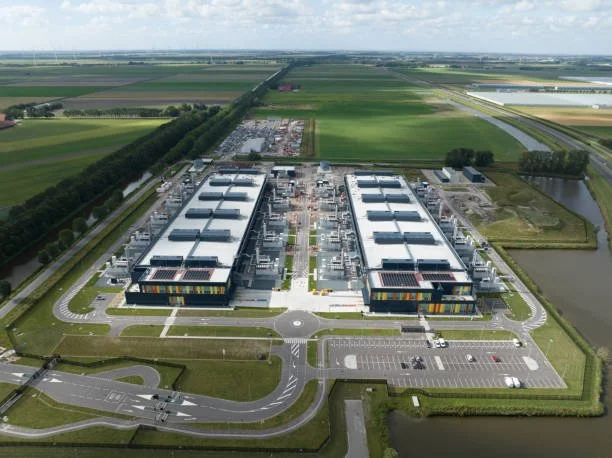
In data centers, heat is the ultimate operational bottleneck. As high-density workloads like Artificial Intelligence (AI) and machine learning expand, server power densities are climbing rapidly. Every gigawatt of AI compute generates a gigawatt of heat (~3.41 billion BTU/hr)! Historically, the industry has countered internal heat generation by scaling up mechanical HVAC systems, chillers, and liquid-cooling loops. However, this approach ignores a massive contributor to the facility's heat budget: external thermal gain through the building envelope.
When a data center’s roof and walls absorb solar radiation, they transform the building into an industrial-scale heat trap. Compounding this, standard air conditioning physics dictates that a higher temperature differential between the inside and outside of the structure forces compressors to consume significantly more energy to move a single watt of heat. To drive down Power Usage Effectiveness (PUE) metrics, operators must move past active, power-hungry mechanical systems and turn to the building's physical skin.
The Dual-Action Physics of Passive Daytime Radiative Cooling
Standard commercial white roof coatings have long been used to lower surface temperatures. However, conventional materials rely heavily on traditional Titanium Dioxide (TiO2) pigments. While TiO2 provides decent solar reflectance, it lacks the secondary physical property necessary to actively cool a structure from the inside out: high infrared thermal emissivity. True Passive Daytime Radiative Cooling (PDRC) requires a surface to execute two thermodynamic processes simultaneously:
Maximize Solar Reflection: Bouncing away incoming shortwave ultraviolet (UV), visible, and near-infrared (NIR) wavelengths before they can be converted into thermal kinetic energy.
Maximize Thermal Emissivity: Radiating internal heat outward via longwave infrared (LWIR) energy, specifically targeting the atmospheric "transparent window" (8–13 μm). Because our atmosphere does not absorb these specific wavelengths, the heat skips the air entirely and radiates directly into the extreme cold of outer space.
Intel Market Research
Pirta’s proprietary formulation accomplishes this dual mechanism by re-engineering the optical physics of light scattering.Inspired by the micro-structures of a silk cocoon, the coating introduces controlled micro-air pockets that scatter light across a broader spectrum than raw pigments can manage.
Breaking Down the Performance Metrics
The performance gap between legacy industrial coatings and advanced PDRC systems is starkly captured by the Solar Reflectance Index (SRI). Calculated via standard ASTM E1980 protocols, SRI integrates both reflectance and emissivity into a single efficiency value.
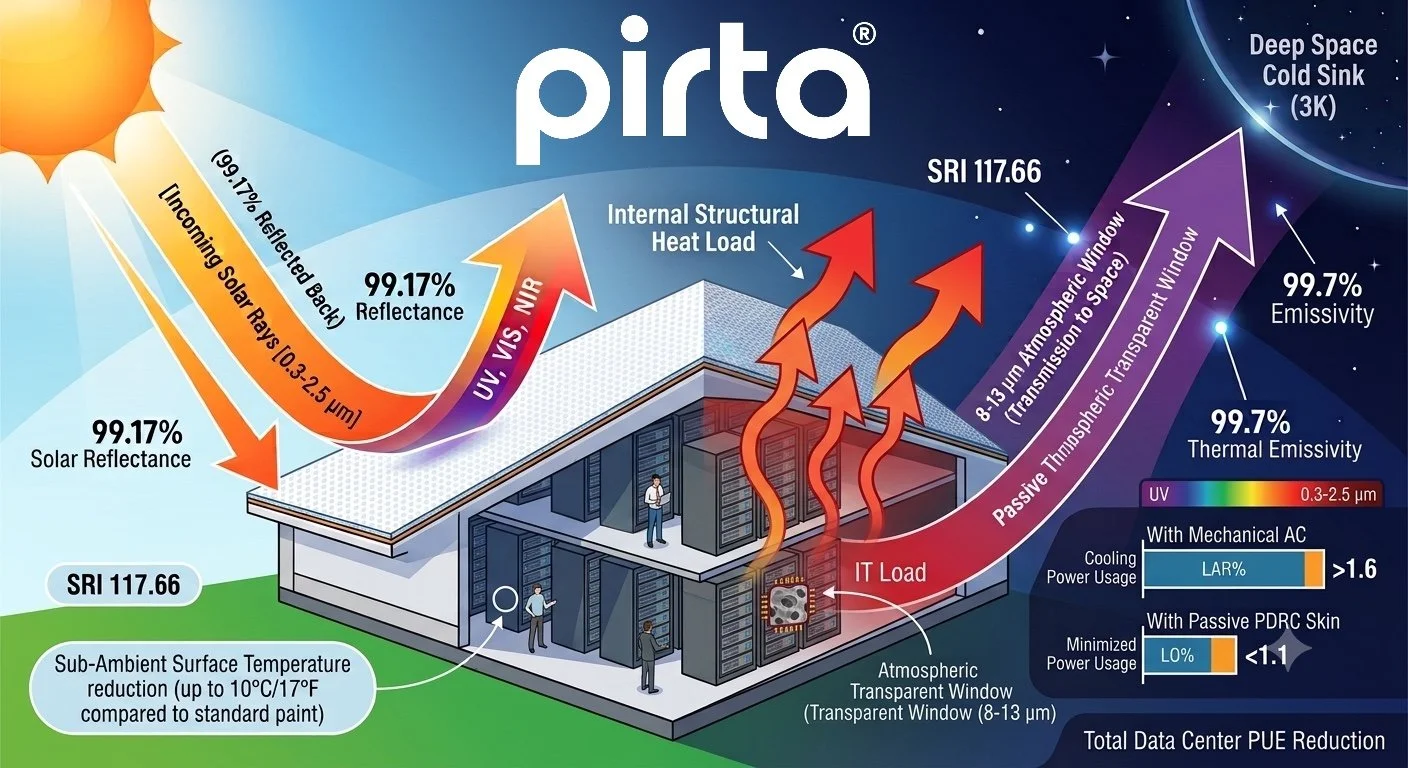
Pirta’s technology achieves metrics that redefine commercial surface physics:
Solar Reflectance: Reaches 99.17% across UV and visible spectra, keeping solar energy from penetrating the substrate.
Thermal Emissivity: Reaches an extraordinary 95% (0.95 on a 0–1 scale), meaning sub-structural heat is effortlessly dumped into the sky.
SRI Score: Evaluates to 117.66. By comparison, standard white paint is indexed at a baseline of 100, while typical grey asphalt shingles hover near a highly absorptive 22.
In field tests, this thermodynamic performance translates directly to real-world infrastructure defense, demonstrating surface temperature drops of up to 64°C (115°F) compared to dark materials such as standard tar roofs, and up to 10°C (17°F) compared to conventional white paint.
De-risking the Grid and Optimizing PUE
For data center infrastructure, these temperature differentials alter the entire financial equation of facility operations. In a standard data center layout, cooling infrastructure typically eats up roughly 37% of the entire facility's electricity budget.
Applying a sub-ambient PDRC skin directly intercepts external heat gain before it can breach the building envelope. Lower surface and structural temperatures reduce the overall thermal load on computer room air conditioners (CRACs) and air handling units (AHUs). By dropping the baseline temperature surrounding intake vents and building surfaces, chiller plants run shorter cycles and consume significantly less kilowatt-hours to maintain strict ASHRAE thermal guidelines.
Furthermore, lowering external structural stress provides an immediate reliability insurance policy against localized grid instability and heatwaves. When ambient summer temperatures peak, substation equipment, housing, and backup generators are vulnerable to thermal runaway. A passive, zero-energy barrier that actively throws off heat ensures critical infrastructure remains well within safe operational limits.
By blending cutting-edge material physics with structural design, data centers can unlock true structural decarbonization—slashing operational costs, stabilizing PUE, and shedding heat directly into space without burning a single additional watt of electricity.
Sources & Technical References
Pirta Ltd. Technical specifications, Nivi formulation data, and ASTM E1980 SRI testing sheets. Available at pirta.com/howpirtaworks and pirta.com/education.University of Leeds & Innovate UK. Product validation and independent field testing reports (2022–2024). Available through Innovate UK Business Connect.Intel Market Research (2026).Passive Daytime Radiative Cooling Materials Market 2026-2034. Assessment of commercial PDRC performance metrics and data center adoption trends.ResearchGate / MDPI (2024).Analysis of Cooling Technologies in the Data Center Sector on the Basis of Patent Applications. Documenting the rise in server power densities and the critical shift toward building envelope optimization.